


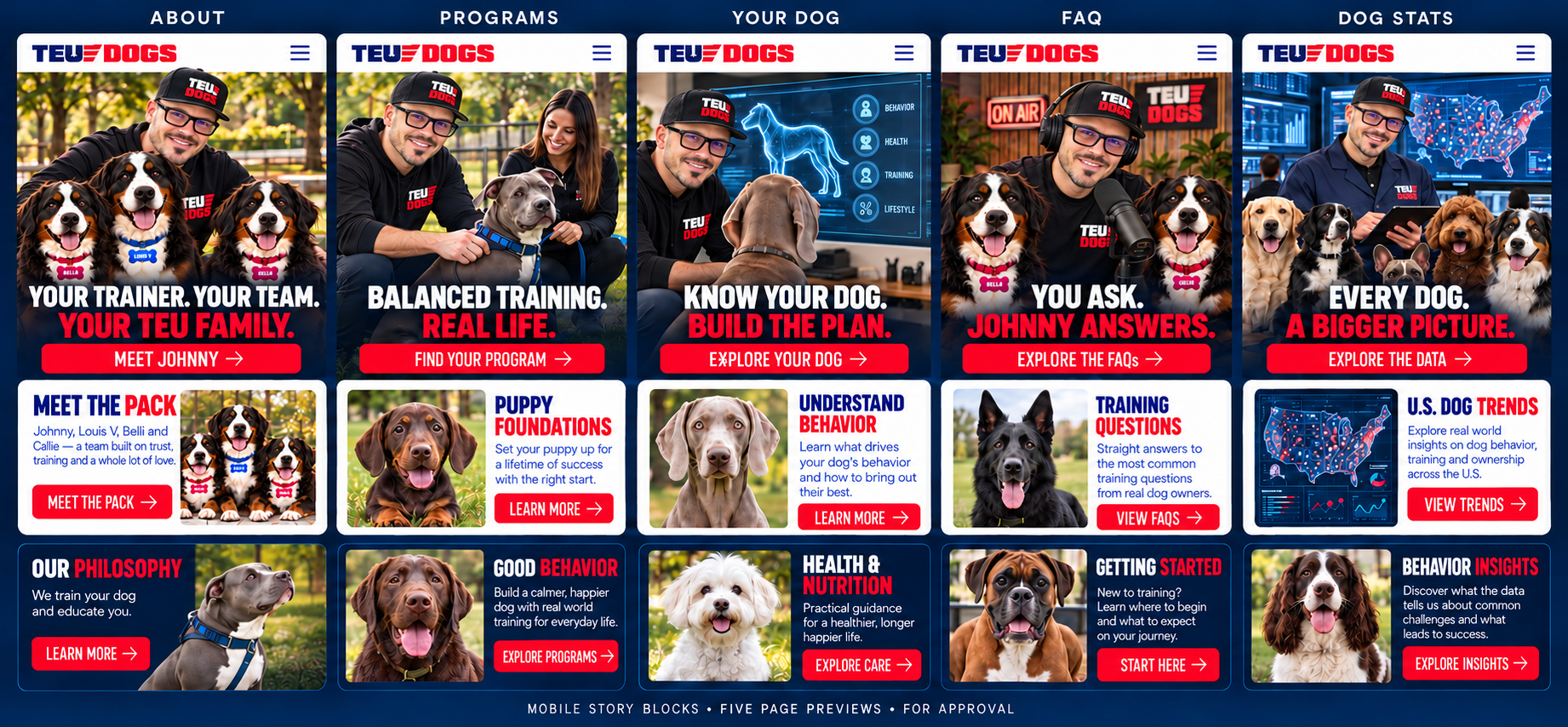
BEHAVIOR INSIGHTS
Discover what the data tells us about common challenges and what helps dogs thrive.
EXPLORE INSIGHTSEvery dog. A bigger picture.
 EXPLORE THE DATA ↓
REAL NUMBERS. REAL REASONS.KNOW MORE.
KNOW MORE.
DO BETTER.
Dogs need more than love. They need understanding, consistency, and clear communication. These numbers show why education deserves a place in every dog’s life.
DOGS. ONE BIG RESPONSIBILITY.
Nearly 90 million dogs lived in the U.S. in AVMA’s 2024 estimate. Understanding them matters.
AVMA · U.S. dog population, 2024 ↗BEHAVIOR WAS THE REASON.
Behavior issues accounted for 35% of dog relinquishment reasons in one Colorado shelter study covering 2018–2023.
Kisley, Chung & Levitt · Shelter records, 2018–2023 ↗THE PROBLEM WENT UNRECOGNIZED.
In a study of 427 relinquished dogs, 69.3% of owners reported no behavior problem. Assessments still found more undesirable behaviors than in matched pet dogs.
Powell et al. · Relinquishing owners, 2021 ↗BITES EACH YEAR.
AVMA reports more than 4.5 million people are bitten by dogs annually in the U.S. Education and supervision are central to prevention.
AVMA · Dog bite prevention, 2026 ↗DOGS ENTERED SHELTERS.
Approximately 2.8 million dogs entered U.S. shelters and rescues in 2025. Every dog deserves a chance to thrive.
ASPCA · U.S. shelter statistics, 2025 ↗BEHAVIOR MATTERED IN RETURNS.
Behavior issues represented 59% of reported reasons for post-adoption returns of cats and dogs in the Colorado study, versus 22% for initial relinquishments.
Kisley, Chung & Levitt · Shelter records, 2018–2023 ↗HOMES WITH A DOG.
Nearly half of U.S. households included a dog in AVMA’s 2024 estimate. Better understanding starts at home.
AVMA · U.S. dog population, 2024 ↗NEW HOMES. NEW BEGINNINGS.
Approximately 2 million dogs were adopted from U.S. shelters and rescues in 2025.
ASPCA · U.S. shelter statistics, 2025 ↗BACK WITH THEIR PEOPLE.
Approximately 542,000 dogs were returned to their owners in 2025, according to ASPCA’s U.S. shelter statistics.
ASPCA · U.S. shelter statistics, 2025 ↗Figures reflect the dates and populations listed on each card. Individual shelter studies describe their samples, not every dog or owner nationwide.
TRAINING VS. NO PUPPY CLASSESEARLY GUIDANCE.
EARLY GUIDANCE.
MEASURABLE DIFFERENCES.
A 2021 survey of 1,023 dogs compared adult behavior in dogs who attended puppy training by six months with those who did not. Here is what researchers found.
LOWER ODDS OF AGGRESSION.
Dogs attending training by six months had 29% lower odds of reported adult aggression than dogs without puppy classes (odds ratio 0.71).
Dinwoodie et al. · 2021 ↗LOWER ODDS OF DESTRUCTION.
Puppy class attendance was associated with 40% lower odds of reported destructive behavior in adulthood (odds ratio 0.60).
Dinwoodie et al. · 2021 ↗LOWER ODDS OF EXCESSIVE BARKING.
Dogs attending puppy classes had 32% lower odds of reported excessive barking as adults (odds ratio 0.68).
Dinwoodie et al. · 2021 ↗Percentages describe lower odds, not percentage-point reductions or guaranteed results. This owner-reported observational study cannot prove training caused the differences. Some outcomes did not improve; house soiling had higher reported odds in the training group. The comparison is puppy-class attendance, not lifelong trained versus never-trained dogs.
LIFESPAN / THE FULL PICTUREMORE TIME.
MORE TIME.
BETTER QUALITY.
What can shorten a dog’s life? Research points to excess weight and differences linked to size, breed, and body shape. Every dog has a different health story.
YEARS LESS, AT THE LARGEST GAP.
Across 50,787 neutered pet dogs from 12 breeds, overweight dogs had shorter median lifespans. The gap ranged from 0.4 years in German Shepherds to 2.5 years in Yorkshire Terriers.
Salt et al. · 2019 ↗SMALL DOGS VS. LARGE DOGS.
In a 2024 UK study, median survival was 12.7 years for small purebreds versus 11.9 for large purebreds. Size and breed matter; these are group estimates.
McMillan et al. · 2024 ↗SHORT MUZZLES. SHORTER SURVIVAL.
Short-muzzled purebreds had median survival of 11.2 years, versus 12.8 for medium-muzzled purebreds in the UK study. This association does not establish the cause for an individual dog.
McMillan et al. · 2024 ↗THE NUMBERS / YOUR NEXT MOVEWHAT THIS MEANS
WHAT THIS MEANS
FOR DAILY LIFE.
Use what we know to make thoughtful choices for your dog.
KEEP THEM
IN HEALTHY SHAPE.
Excess weight is associated with shorter survival. Ask your veterinarian to assess your dog’s body condition and feeding needs.
START WITH A BODY-CONDITION CHECK.KNOW THE DOG
IN FRONT OF YOU.
Breed, body size, and muzzle shape are linked to longevity differences. Population numbers cannot predict your dog’s exact lifespan.
MATCH CARE TO THEIR INDIVIDUAL NEEDS.BUILD BETTER
EVERYDAY ROUTINES.
Use training to build manageable routines and clear communication. The lifespan studies here did not test whether training adds years to a dog’s life.
PRACTICE CONSISTENT COMMUNICATION.GOOD NEWS / PROGRESS IS POSSIBLEBETTER CARE.
BETTER CARE.
MORE GOOD YEARS.
The evidence offers reasons for optimism: longer lives in some populations, benefits from carefully managed nutrition, and better obedience linked to reward-based training.
A LONGER LIFE IN TOKYO.
A 2018 cemetery-data study reported that life expectancy in Tokyo had risen from 8.6 to 13.7 years over roughly three decades. This is a regional comparison, not a global average.
Inoue et al. · 2018 ↗YEARS IN A CONTROLLED STUDY.
A lifetime study of 48 Labrador Retrievers found 1.8 years longer median lifespan and later onset of some diseases in its diet-restricted group. This research result is not an individual feeding prescription.
Lawler et al. · 2008 ↗OWNERS. BETTER OBEDIENCE.
In a survey of 364 owners, greater use of reward-based training was associated with better reported obedience. It was an observational study, not a guaranteed improvement for every dog.
Hiby, Rooney & Bradshaw · 2004 ↗These studies measure different populations and outcomes. Together they support investing in care and education; they do not show that one change explains all lifespan gains. Work with your veterinarian on your dog’s nutrition, body condition, and health needs.
NUTRITION / HEALTH / LONGEVITYFEED WITH PURPOSE.
FEED WITH PURPOSE.
HELP THEM THRIVE.
A healthy diet supplies the right nutrients and calories for the dog in front of you. Complete nutrition, appropriate portions, and healthy body condition are the foundation.
BUILD THE BOWL AROUND BALANCE.
AAHA recommends at least 90% of daily calories from complete and balanced food, with no more than 10% from treats and other extras. Count training rewards in that allowance.
AAHA · Nutrition guidelines ↗HOMEMADE NEEDS EXPERT FORMULATION.
A UC Davis study found at least one essential nutrient deficiency in 95% of 200 evaluated homemade recipes. This describes those recipes, not all homemade food.
UC Davis · Recipe analysis ↗HEALTHY BODY CONDITION MATTERS.
On the standard nine-point canine body-condition scale, 4–5 is ideal. Your veterinarian can assess fat and muscle, then match portions to your dog’s needs.
WSAVA · Canine body-condition chart ↗WHAT KIND OF FOOD IS BEST?THE RIGHT FORMULA.
01 / FRESH COOKED 02 / WET OR DRY 03 / HOME COOKED 04 / RAW FOOD
THE RIGHT FORMULA.
THE RIGHT FIT.
Choose a complete and balanced diet for your dog’s life stage and health needs. Compare nutritional adequacy, formulation expertise, and quality control—not just ingredient names or packaging. Food format alone does not establish a longevity benefit.
FRESH CAN BE A GOOD FIT.
Choose a commercially prepared cooked diet with a complete-and-balanced statement for your dog’s life stage. Follow storage instructions and count calories. Fresh ingredients alone do not ensure balance.
CHECK THE NUTRITION.
Wet food and kibble can meet nutritional requirements when complete and balanced. Evaluate the formula, manufacturer’s expertise, and your dog’s tolerance. A format label does not tell the whole health story.
PERSONALIZED. PROFESSIONALLY PLANNED.
Use a recipe formulated for your dog by a board-certified veterinary nutritionist. Follow the ingredients and supplements exactly; meat and vegetables alone may leave important nutrient gaps.
UNDERSTAND THE EVIDENCE.
WSAVA reports no demonstrated health advantage over balanced cooked or commercial diets. Raw meat can carry pathogens that affect pets and people. Discuss diet choices with your veterinarian.
MAKE EVERYDAY FEEDING WORK.
Match the life stage. Puppies, adults, and dogs with medical conditions have different nutritional needs. For large-breed puppies, check that the food’s adequacy statement includes their growth needs.
Measure the calories. Include treats, chews, toppers, and training rewards. Use part of the daily food allowance for training when appropriate.
Keep the whole diet balanced. Supplements and “superfoods” are not substitutes for a complete diet. Check additions with your veterinarian.
Watch the dog, not just the bowl. Review weight, body condition, appetite, stool, and tolerance with your veterinary team. Individual nutrition plans matter more than a universal “best food.”
The 90/10 ratio and body-condition score are clinical guidelines; the recipe figure is a study result. Food choices here are educational guidance, not TEU brand endorsements. Ask your veterinarian or a board-certified veterinary nutritionist for an individualized plan.
TURN KNOWLEDGE INTO ACTION.BETTER GUIDANCE.
EXPLORE TEU PROGRAMS ↗
BETTER GUIDANCE.
BRIGHTER FUTURES.
MORE CONFIDENCEBuild trust through clear communication.
STRONGER BONDSMake daily life together more rewarding.
BETTER HABITSPractice the behaviors you want to see.
HAPPIER DOGSUnderstand the dog in front of you.